






Cal Tint Universal Paint Colorant
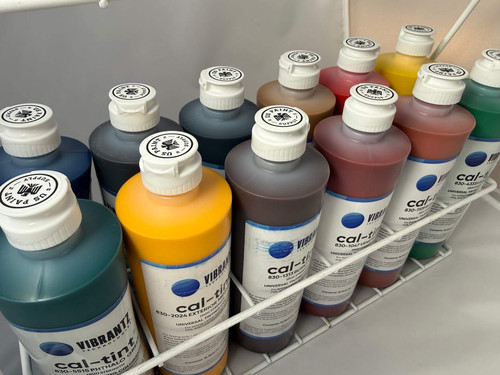
Just getting started? Not sure which colors you need or need a portable carrying solution? Check out the the Cal-Tint Starter Set that comes with 12 colors and a custom carrying rack. This is the most popular solution for artists at theaters, studios, and theme parks.
Cal-Tint 830 is a Universal Paint Colorant designed to be compatible with most water-based and solvent-based paints, plasters, putties, and other decorative coatings. Cal-Tint has been the industry standard for reliability for well over 30 years at this point. It provides repeatability due to it's extremely accurate production, and our custom dispensing cap only available from US Paint Supply.
Universal Paint Tint
Cal-Tint is a "Universal Paint Tint". It works with nearly every water-based and many solvent-based systems. Our customers send us photos from film sets, TV shows, theme parks, community theaters, restoration shops, and plenty of home projects. It is easy to work with and clean up because of the custom dispensing caps we include with every purchase. The easy-to-use squeeze bottles allow easy control of the amount of colorant you need, while keeping the process clean. No more worrying about drips going down the side of your paint can while tinting paint!
- Packaged in 16oz. squeeze bottles - perfect for quick, easy, and clean tinting on-the-job
- Extremely strong and consistent
- Most colors (anything not labeled "interior") are formulated to be light-fast, allowing for use on outdoor/UV exposed surfaces
- Custom dispensing cap from US Paint Supply only. Our competitors no longer supply dispensing caps!
Cal-Tint Colors: Full List, Numbers & Spec Sheets
- Bulletin Red 830-0802
- Burnt Sienna 830-1109
- Burnt Umber 830-1313
- Exterior Light Yellow 830-2501
- Exterior Medium Yellow 830-2024
- Interior Yellow 830-2506
- Lamp Black 830-9907
- Light Green 830-4333
- Perma Cal Orange 830-0979
- Permanent Red 830-0494
- Phthalo Blue 830-7216
- Phthalo Green 830-5515
- Raw Sienna 830-1824
- Raw Umber 830-2009
- Venetian Red 830-1047
- Violet 830-8895
Cal-Tint Bulletin Red (830-0802)
Sign painters use Bulletin Red for lettering and bulletin work. The name comes from that trade use. Chromaflo pairs a naphthol red with a quinacridone violet.
- Pigments: PR 188 and PV 19 (organic)
- Lightfastness: 8 of 8 on the Blue Wool scale
- Tinting strength: High
- Weight: about 1.44 lbs per pint.
- 830-0802 safety data sheet
Cal-Tint Burnt Sienna (830-1109)
Burnt Sienna is an earth orange-brown. Chromaflo blends yellow oxide, red oxide, and carbon black to make it. The three-pigment blend gives a more muted tone than a single oxide.
- Pigments: PY 42, PR 101, and PBk 7 (earth)
- Lightfastness: 8 of 8 on the Blue Wool scale
- Tinting strength: Moderate to high
- Weight: about 1.93 lbs per pint.
- 830-1109 safety data sheet
Cal-Tint Burnt Umber (830-1313)
Burnt umber is calcined umber. Calcination roasts the pigment and makes it warmer than raw umber. Painters use it to add warmth and depth to off-whites and tans.
- Pigments: PBr 7, calcined (earth)
- Lightfastness: 8 of 8 on the Blue Wool scale
- Tinting strength: Moderate
- Weight: about 1.74 lbs per pint.
- 830-1313 safety data sheet
Cal-Tint Exterior Light Yellow (830-2501)
Exterior Light Yellow is the lighter of the two exterior yellows. Chromaflo combines an arylide yellow with bismuth vanadate. It is the only yellow in the 830 series with a full 8 lightfastness rating.
- Pigments: PY 74 and PY 184 (organic)
- Lightfastness: 8 of 8 on the Blue Wool scale
- Tinting strength: Moderate
- Weight: about 1.48 lbs per pint.
- 830-2501 safety data sheet
Cal-Tint Exterior Medium Yellow (830-2024)
Exterior Medium Yellow is the deeper of the two exterior yellows. Chromaflo abbreviates the name to Exterior Med Yellow on the 830 line sheet, so catalogs and order forms use both forms. It combines two arylide yellows.
- Pigments: PY 65 and PY 74 (organic)
- Lightfastness: 7 of 8 on the Blue Wool scale
- Tinting strength: Moderate
- Weight: about 1.48 lbs per pint.
- 830-2024 safety data sheet
Cal-Tint Interior Yellow (830-2506)
Interior Yellow is the only color in the 830 series that Chromaflo restricts to interior use. Do not use it in an exterior coating. Choose one of the two exterior yellows instead.
- Pigments: PY 74 and PY 3 (organic)
- Lightfastness: 7 of 8 on the Blue Wool scale
- Tinting strength: Moderate
- Weight: about 1.50 lbs per pint.
- 830-2506 safety data sheet
Cal-Tint Lamp Black (830-9907)
Lamp Black also appears as lampblack and as carbon black. Painters use it to mix greys and taupes. It darkens a color without a hue shift. Tinting strength is extremely high, so add it in small amounts.
- Pigments: PBk 7 (carbon)
- Lightfastness: 8 of 8 on the Blue Wool scale
- Tinting strength: Extremely high
- Weight: about 1.44 lbs per pint.
- 830-9907 safety data sheet
Cal-Tint Light Green (830-4333)
Light Green is a blend rather than a single pigment. Chromaflo mixes phthalo green with yellow oxide, which pulls the green toward olive. Phthalo Green is the cleaner and deeper green in the series.
- Pigments: PG 7 and PY 42 (mixed)
- Lightfastness: Not published
- Tinting strength: Moderate to high
- Weight: about 1.62 lbs per pint.
- 830-4333 safety data sheet
Cal-Tint Perma Cal Orange (830-0979)
Some distributor catalogs list Perma Cal Orange as Permanent Orange. Both names refer to part number 830-0979. Chromaflo combines a diarylide orange with a benzimidazolone orange.
- Pigments: PO 34 and PO 36 (organic)
- Lightfastness: Not published
- Tinting strength: High
- Weight: about 1.35 lbs per pint. This is the lightest colorant in the 830 series.
- 830-0979 safety data sheet
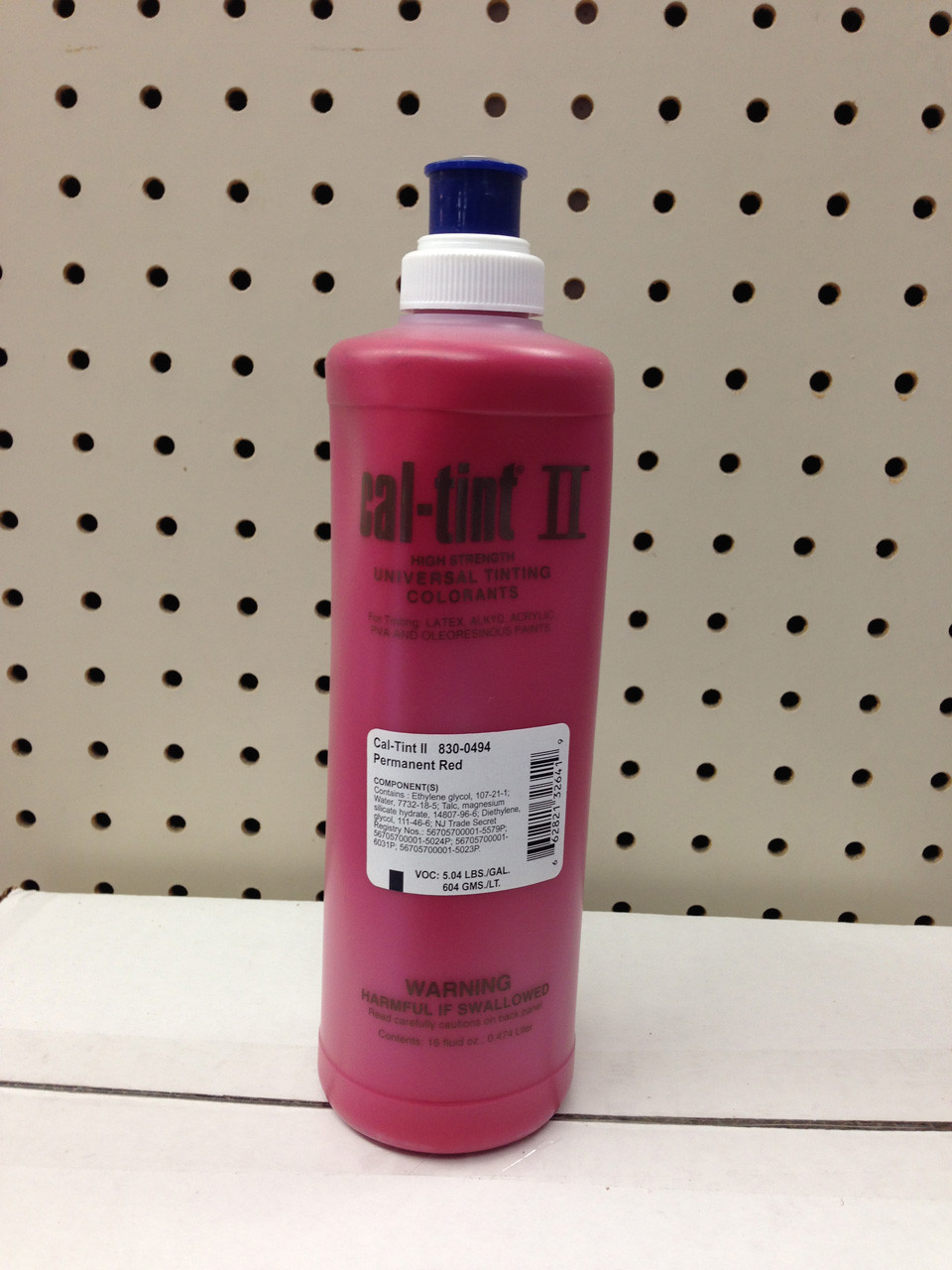
Cal-Tint Permanent Red (830-0494)
Catalogs list this color as Permanent Red and as Permanent Organic Red. Chromaflo combines a diketopyrrolopyrrole red with a quinacridone violet. It is the organic red in the 830 series, and Venetian Red is the iron-oxide red.
- Pigments: PR 255 and PV 19 (organic)
- Lightfastness: 8 of 8 on the Blue Wool scale
- Tinting strength: High
- Weight: about 1.38 lbs per pint.
- 830-0494 safety data sheet
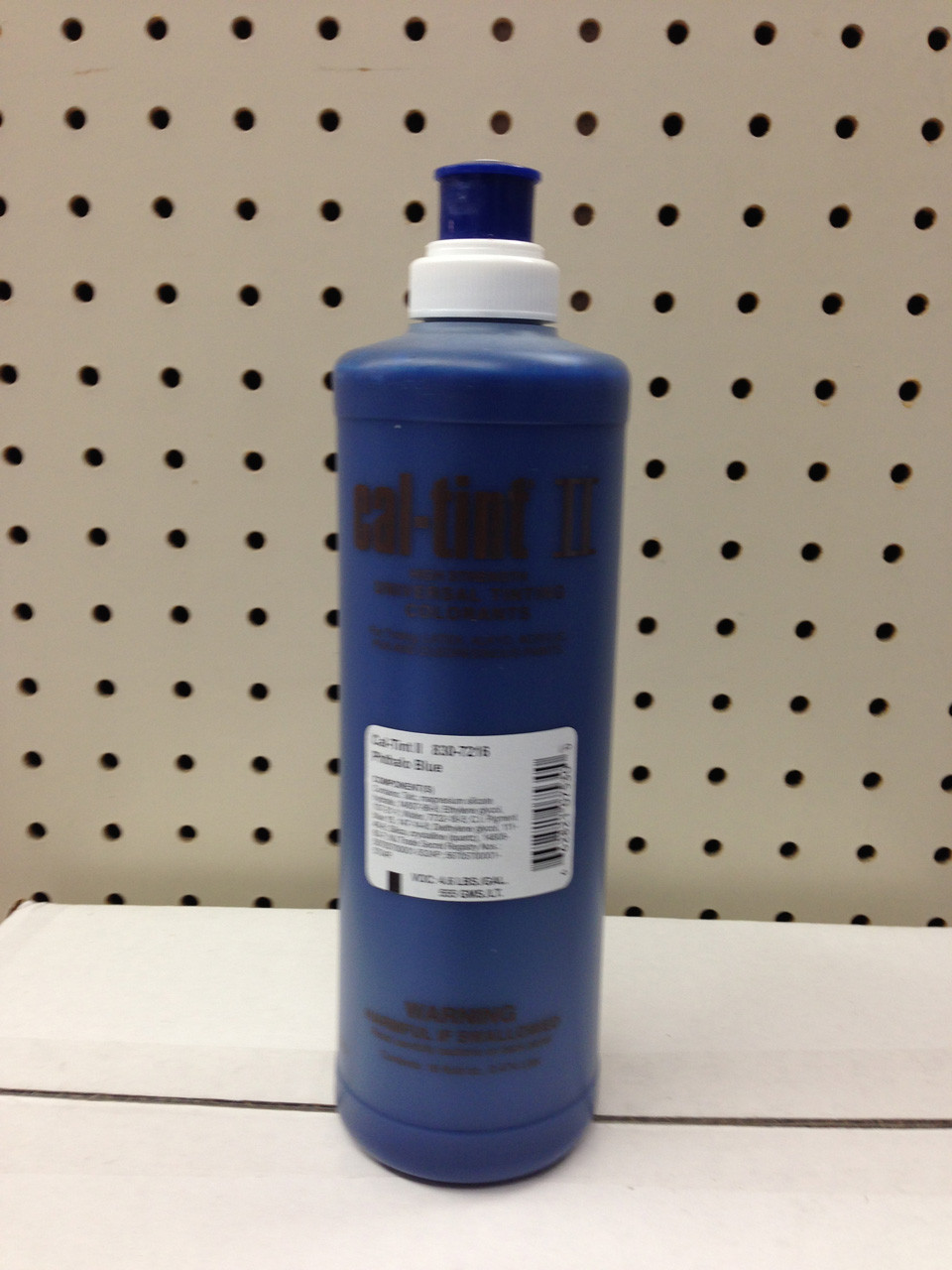
Cal-Tint Phthalo Blue (830-7216)
The trade also spells this color Thalo Blue. Chromaflo uses a single phthalocyanine blue pigment. Tinting strength is extremely high, so add small amounts and check the color often.
- Pigments: PB 15:2 (organic)
- Lightfastness: 8 of 8 on the Blue Wool scale
- Tinting strength: Extremely high
- Weight: about 1.44 lbs per pint.
- 830-7216 safety data sheet
Cal-Tint Phthalo Green (830-5515)
The trade also spells this color Thalo Green. Chromaflo uses a single phthalocyanine green pigment. It is the green match to Phthalo Blue, and its tinting strength is just as high.
- Pigments: PG 7 (organic)
- Lightfastness: 8 of 8 on the Blue Wool scale
- Tinting strength: Extremely high
- Weight: about 1.51 lbs per pint.
- 830-5515 safety data sheet
Cal-Tint Raw Sienna / Yellow Oxide (830-1824)
Chromaflo lists part number 830-1824 as Raw Sienna/Yellow Oxide. Painters also call this color yellow ochre. All three names refer to the same product. The pigment is a single yellow iron oxide.
- Pigments: PY 42 (earth)
- Lightfastness: 8 of 8 on the Blue Wool scale
- Tinting strength: Moderate
- Weight: about 1.86 lbs per pint.
- 830-1824 safety data sheet
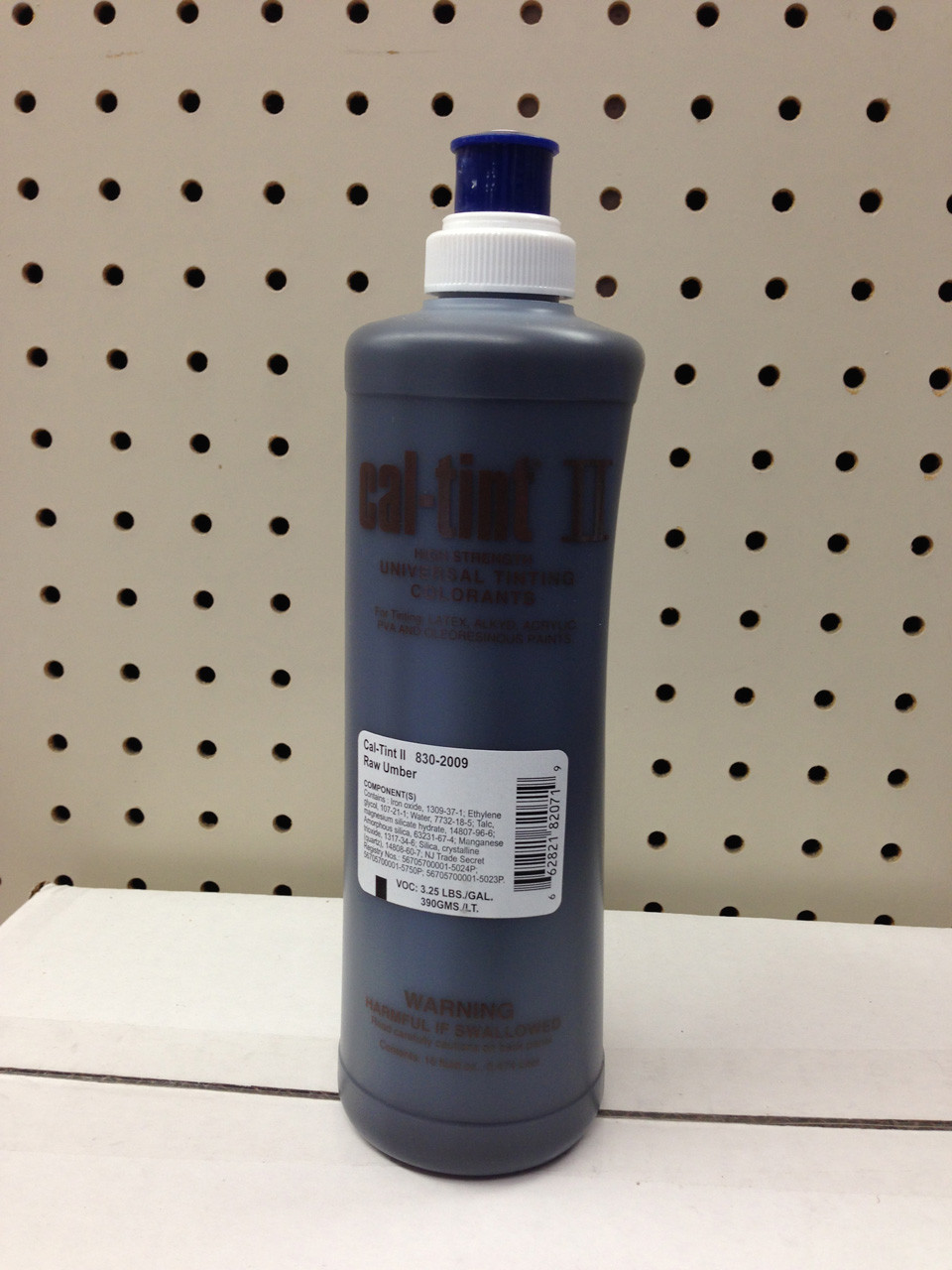
Cal-Tint Raw Umber (830-2009)
Raw Umber is a natural brown iron-oxide earth. It is cooler and greener than burnt umber because Chromaflo does not calcine the pigment. Painters use it to grey and age a color.
- Pigments: PBr 7 (earth)
- Lightfastness: 8 of 8 on the Blue Wool scale
- Tinting strength: Moderate
- Weight: about 1.65 lbs per pint.
- 830-2009 safety data sheet
Cal-Tint Venetian Red (830-1047)
Venetian Red is a red oxide earth tone. Many painters call this color red oxide. The pigment is a single red iron oxide.
- Pigments: PR 101 (iron oxide)
- Lightfastness: 8 of 8 on the Blue Wool scale
- Tinting strength: Very high
- Weight: about 2.11 lbs per pint. This is the heaviest colorant in the 830 series.
- 830-1047 safety data sheet
Cal-Tint Violet (830-8895)
Catalogs also identify this color as dioxazine violet or carbazole violet. Chromaflo uses a single carbazole dioxazine pigment. Chromaflo does not publish a lightfastness rating for this color.
- Pigments: PV 23 (organic)
- Lightfastness: Not published
- Tinting strength: High
- Weight: about 1.38 lbs per pint.
- 830-8895 safety data sheet
Cal-Tint Product Line Sheet
The 830 line sheet covers compatibility notes and specifications for all 16 colors. Read the Chromaflo Cal-Tint 830 product line sheet.
Cal-Tint & Colortrend FAQ
- Are Cal-Tint 830 colorants truly "universal"?
- Cal-Tint 830 colorants are formulated for broad compatibility in architectural trade sales coatings, including latex systems (PVA, acrylic, styrene-butadiene, alkyd-modified emulsions, and other water-based systems) and conventional solvent-type finishes (flat through gloss alkyd enamels, oil-type house paints, sash & trim paints, and wood stains). Always recheck compatibility if the base paint formula changes. It's important to understand the concept of "maximum tint load" - you can't continually add more colorant, there is a maximum amount that can be suspended in any given base.
- What’s the relationship between Cal-Tint 830 and Colortrend 888?
- They correspond to roughly the same universal colorant technology. 830 is packaged in 16-oz squeeze bottles for on-the-job tinting, while 888 is the machine-dispensable version used in volumetric tinting systems and comes in quarts/gallons.
- Can I use these colorants in exterior paints?
- Yes. Except anything labeled "interior". Organic reds and yellows are more sensitive to high-UV environments. In such conditions, evaluate the specific colorant/base combination or favor iron-oxide/earth tones for best long-term performance.
- Will these work in solvent-based paints and wood stains?
- Yes. Cal-Tint contains glycol which helps it mix/suspend. The 830 series is compatible with many solvent-type architectural coatings, including alkyd enamels, oil-type house paints, and wood stains. Always do a small test batch before committing to production or job use. The maximum tint load in solvent-based bases will be lower than water-based bases.
- Do I need special equipment to dispense them?
- No. We fit every bottle (by hand) with special dispensing caps before shipping. Just manually squeeze from the plastic bottle. If you plan to use them in a machine, we recommend considering the 888 colorant line. Contact us for more info.
- How consistent is the tint strength from bottle to bottle?
- Vibrantz controls colorants to a tint-strength tolerance of ±1% by volume (ΔE < 0.5 vs. standard).
- Do the colorants settle or form a skin?
- They do settle, but generally do not form a skin. The glycol will rise to the top after the bottle sits for weeks. We shake each bottle upon receipt, and before shipping to you. Generally about 10-15s of shaking is enough, but if you need exact repeatability we'd recommend 1-2 minutes by hand or just use a machine.
- How many VOCs does cal-tint have?
- VOC varies per color. Values range in the several-hundred g/L range. The effect on your final paint depends on how much colorant you add: added VOC ≈ (colorant VOC × colorant volume) ÷ total paint volume. Check the TDS for the specific color and confirm local VOC compliance for your use case.
- Do these colorants work in specialty 2K systems (epoxies, polyurethanes)?
- In very small amounts, yes. Remember that tint load is extremely important. We have used it successfully in ML Campbell lacquer over the years.
- Can I mix different Cal-Tint colors together?
- Absolutely. The colorants are designed to be used in professional systems where they are blended to reach target shades. Generally we like recording additions by weight(grams) for the most precise repeatability. If you just need rough repeatability, measure by "drops" out of the dispensing cap.