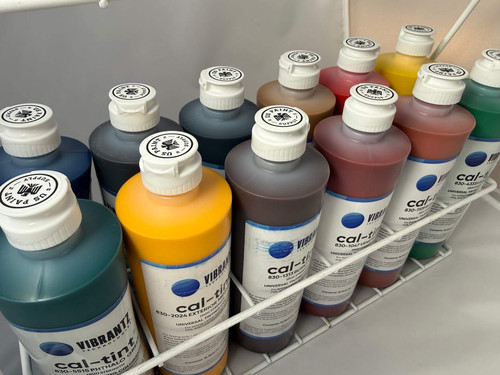


Cal Tint Universal Paint Colorant
Cal-Tint 830 colorants are designed to be compatible with most water-based and solvent-based paints, plasters, putties, and other decorative coatings. We've been selling Cal-Tint for more than 30 years, there's a reason it's a standard! It provides repeatability due to it's extremely accurate production.
We're the only supplier who provides dispensing caps
As of January 2025, you'll find that all other suppliers only provide screw caps - we change each cap by hand and install the custom US Paint Supply flip top dispensing cap.
First timer with a big project?
If you're just getting started or need a way to transport bottles around your workspace easily, check out the the Cal-Tint Starter Set with the 12 standard colors and a metal carrying rack.
What is a "Universal Paint Tint"?
Cal-Tint is a "Universal Paint Tint". Universal Tints work with nearly every water-based and many solvent-based systems. Cal-Tint contains extremely concentrated pigments along with other ingredients (like glycol) which allow it to mix in most common bases. Over the years we've seen our customers use Cal Tint in paint, stains, plaster, lacquer, grout, and countless other bases across film sets, TV shows, theme parks, community theaters, restoration shops, and plenty of home projects
Cal-Tint Color List
| Color | SKU | Weight | Safety data sheet |
|---|---|---|---|
| Bulletin Red | 830-0802 | 1.44 lbs/pt | |
| Burnt Sienna | 830-1109 | 1.93 lbs/pt | |
| Burnt Umber | 830-1313 | 1.74 lbs/pt | |
| Exterior Light Yellow | 830-2501 | 1.48 lbs/pt | |
| Exterior Medium Yellow | 830-2024 | 1.48 lbs/pt | |
| Interior Yellow | 830-2506 | 1.50 lbs/pt | |
| Lamp Black | 830-9907 | 1.44 lbs/pt | |
| Light Green | 830-4333 | 1.62 lbs/pt | |
| Perma Cal Orange | 830-0979 | 1.35 lbs/pt | |
| Permanent Red | 830-0494 | 1.38 lbs/pt | |
| Phthalo Blue | 830-7216 | 1.44 lbs/pt | |
| Phthalo Green | 830-5515 | 1.51 lbs/pt | |
| Raw Sienna / Yellow Oxide | 830-1824 | 1.86 lbs/pt | |
| Raw Umber | 830-2009 | 1.65 lbs/pt | |
| Venetian Red | 830-1047 | 2.11 lbs/pt | |
| Violet | 830-8895 | 1.38 lbs/pt |
Full Line Sheet
The 830 line sheet covers compatibility notes and specifications for all 16 colors. Read the Chromaflo Cal-Tint 830 product line sheet.
Cal-Tint & Colortrend FAQ
- Are Cal-Tint 830 colorants truly "universal"?
- They're considered to have broad compatibility in architectural trade sales coatings, including latex systems (PVA, acrylic, styrene-butadiene, alkyd-modified emulsions, and other water-based systems) and conventional solvent-type finishes (flat through gloss alkyd enamels, oil-type house paints, sash & trim paints, and wood stains). Always recheck compatibility if the base paint formula changes. It's important to understand the concept of "maximum tint load" - you can't continually add more colorant, there is a maximum amount that can be suspended in any given base.
- What’s the relationship between Cal-Tint 830 and Colortrend 888?
- They correspond to roughly the same universal colorant technology. 830 is packaged in 16-oz squeeze bottles while 888 is the machine-dispensable version used in volumetric tinting systems and comes in quarts/gallons.
- Can I use these colorants in exterior paints?
- Yes - except colors labeled "interior" and the caveat that organic reds and yellows are more sensitive to high-UV environments. In such conditions, evaluate the specific colorant/base combination or favor iron-oxide/earth tones for best long-term performance.
- Will these work in solvent-based paints and wood stains?
- Within reason (typically 1-2%), yes. Cal-Tint contains glycol which helps it mix/suspend. The 830 series is compatible with many solvent-type architectural coatings, including alkyd enamels, oil-type house paints, and wood stains. Always do a small test batch before committing to production or job use. The maximum tint load in solvent-based bases will be lower than water-based bases.
- Do I need special equipment to dispense them?
- No. We fit every bottle (by hand) with special dispensing caps before shipping. Just manually squeeze from the plastic bottle. If you plan to use them in a machine, we recommend considering the 888 colorant line. Contact us for more info.
- How consistent is the tint strength from bottle to bottle?
- Vibrantz controls colorants to a tint-strength tolerance of ±1% by volume (ΔE < 0.5 vs. standard).
- Do the colorants settle or form a skin?
- They do settle, but generally do not form a skin. The glycol will rise to the top after the bottle sits for weeks. We shake each bottle upon receipt, and while packing each order. Generally about 10-15s of shaking is enough, but if you need exact repeatability we'd recommend 1-2 minutes by hand or just use a machine.
- How many VOCs does cal-tint have?
- VOC varies per color. Values range in the several-hundred g/L range. The effect on your final paint depends on how much colorant you add: added VOC ≈ (colorant VOC × colorant volume) ÷ total paint volume. Check the TDS for the specific color and confirm local VOC compliance for your use case.
- Do these colorants work in specialty 2K systems (epoxies, polyurethanes)?
- In very small amounts, yes. Remember that tint load is extremely important. We have used it successfully in ML Campbell lacquer over the years.
- Can I mix different Cal-Tint colors together?
- Absolutely. The colorants are designed to be used in professional systems where they are blended to reach target shades. Generally we like recording additions by weight(grams) for the most precise repeatability. If you just need rough repeatability, measure by "drops" out of the dispensing cap.