
Why Paint Brands Use Black Colorant – And Why Some Don’t
Posted by Tommy Ekstrand on 11/28/2025
Our goal here at US Paint Supply is to help you understand how choices (like using black) show up in real rooms, so you can pick the paint that aligns with your expectations.
If you’ve ever watched a paint store tint a gallon and noticed a shot of black going into a paint can, you might wonder "But why?". In this article, we'll explain what black pigment in paint actually does, how it fits into a simple 3D model of color, and why many coatings manufacturers rely on black pigment in paint to control cost and performance—especially in whites and neutrals. We'll also look at why some premium brands, like C2, choose not to use black at all in their color system, and what that means for you as a homeowner or pro.
Why Paint Needs Colorant in the First Place
Most architectural paints start out as a "base". This is usually a white or near-white liquid with binders and additives but very little color on its own. To get the thousands of colors you see on a fan deck, the paint store adds concentrated colorants.
Those colorants are ultra-strong pigment dispersions. A small amount can shift a gallon of paint from soft white to charcoal, or from light beige to deep navy. Black is one of those colorants, but it's very powerful, and different in an important way.
- Base = the starting paint (often a white or neutral).
- Colorants = concentrated pigments (including black) added in small doses.
- Formula = specific "recipe" of colorants that produce a given chip color.
When you see the tint machine push out a few shots of black, you're seeing one of the most influential colorants in the entire formula.
What Black Pigment in Paint Actually Does
At the most basic level, black pigment darkens the paint. But that's only part of the story. Because black absorbs light across the spectrum, it also affects how intense (or dull) a color appears and can even change the way undertones show up on the wall.
When you add black to a color a few things happen:
- The color gets darker.
- The color because more gray or muted.
- Some of the original "clean" character of the hue is softened or dulled.
Understanding Paint Color as a 3D Space
Most of us often talk about color in one dimension: "lighter vs. darker." In reality, paint color lives in a sort of 3D space. It is very important to understand that humans perceive only 4 unique colors: Red, Green, Blue, and Yellow.
You don’t need to memorize the science, but a basic understanding helps explain what black pigment is doing. Think of each color as a point in a three-axis space.
1. Perceived Lightness(Light/Dark)
This axis runs from pure white at the top the absense of light(or, pure black) at the bottom. When you add black, you're moving the color down on this axis making it darker.
2. A - Green<->Red
Moving to the <-left(negative) becomes more green, to the ->right(positive) more red.
3. B - Blue<->Yellow
Moving to the <-left(negative) becomes more blue, to the ->right(positive) more yellow.
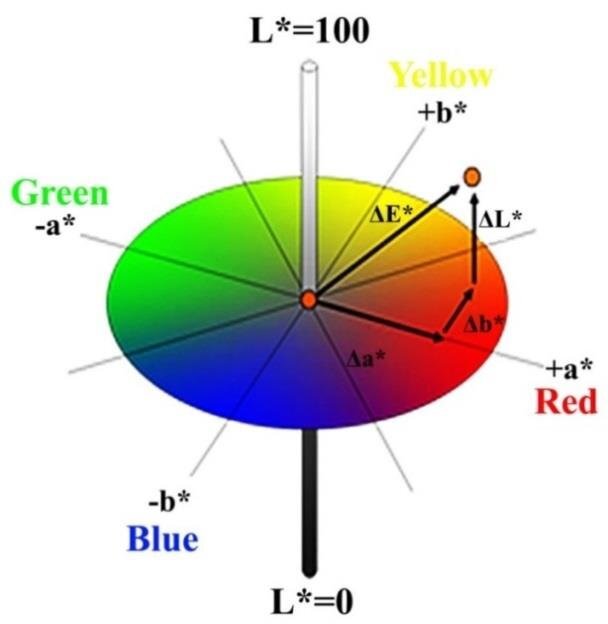
So what?
When black pigment goes into a formula, it's not just making the color darker; it's moving that point in 3D space—down and often inward (less chroma, more gray, more dull).
For in depth reading, check out the CIELAB Color Space article on Wikipedia.
Dechromatization: Why Adding Black Can Make Colors Look “Dirty”
Dechromatization is a technical way of saying "reducing the intensity of a color." Black is one of the most common tools for doing this because it is the cheapest.
Imagine a clean, bright blue:
- Add white → it becomes a lighter, pastel blue (higher lightness, still relatively clean).
- Add black → it becomes a darker, more muted navy or slate (lower lightness, lower chroma).
The black doesn’t just make it darker; it often pulls the color toward a more neutral, sometimes “muddy” or “dirty” appearance. That’s dechromatization.
This is especially noticeable with subtle colors like off-whites, greiges, and light beiges. A touch of black can take a warm, complex white and make it:
- Look slightly dingy compared to a cleaner white.
- Show a stronger gray cast in low light.
- Feel a bit flat or lifeless next to a more pigment-rich color that doesn’t rely on black.
That "dirty" feel isn’t always bad. Sometimes it's exactly what the designer wants. But it's important to understand what’s happening when black is in the mix.
Other ways to dechromatize a paint
Artists typically understand this well, there are many approaches, but rarely does an artist use black. They are use complimentary or offset pigments in order to "deepen" to their desired color.
How (and WHY) Manufacturers Use Black Pigment
Most large paint manufacturers include black as a standard part of their tint systems, and it shows up in a wide range of colors, not just dark charcoal or true black.
1. Controlling Cost (Especially in Whites)
There is no skirting this fact. Black is the cheapest pigment.
This is one of the key reasons black is so widely used. Many of the pigments needed to create rich, nuanced colors(particularly in yellows, reds, and certain blues) are more expensive.
By using black:
- Manufacturers can hit a target color with less of the expensive chromatic pigments.
- They can create a huge range of whites and neutrals using a relatively simple, cost-effective system.
- They can keep prices competitive in a crowded market.
In other words, black often plays double duty: it shapes the look of the color and helps keep the formula economical—especially in high-volume shades like whites and off-whites.
2. Creating Whites, Off-Whites, and Grays
A big portion of the white, off-white, and gray colors on a typical fan deck are built with some amount of black colorant. A tiny shot of black in a white base can create:
- Cool grays and "greiges"
- Softer whites that hide imperfections better than stark, bright white
- Neutral backdrops for contemporary interiors
From a manufacturing perspective, this is a flexible, repeatable way to build a huge range of very popular neutrals.
3. Improving Coverage and Hiding
Black pigment absorbs light strongly, which can help the paint hide previous colors on the wall. In some formulas, a bit of black can improve coverage, especially in midtones and darker colors.
The trade-off is that the color may feel more neutralized and less "alive," particularly if you’re comparing it side-by-side with a color built from more varied pigments.
Why Some Premium Brands Avoid Black Colorant
Some high-end paint brands take a different approach: they choose not to use black colorant at all in their color system. Instead, they build colors using a wider range of chromatic pigments—multiple reds, yellows, blues, and earth tones layered together.
The idea is to create what’s often called a "full-spectrum" color:
- Colors that shift subtly with changing light instead of going flat or chalky.
- Neutrals that feel rich and complex rather than simply "gray."
- Whites that stay luminous and resist that dull, dingy look.
This doesn’t mean black-tinted colors are bad or unusable; plenty of beautiful rooms are painted with them. But it does create a different look and feel, especially in subtle shades.
Where US Paint Supply and C2 Paint Fit In
Our goal at US Paint Supply isn't to say that other brands are wrong for using black; it's to help you understand how these choices show up in real rooms, so you can pick the paint that aligns with your expectations.
One of the reasons we’ve chosen to carry C2 Paint is that their color system doesn't rely on black colorant in their colors. Instead, C2 uses a broader palette of high-quality pigments to build depth and nuance into their colors.
In practical terms, that can mean:
- Whites and neutrals that stay clean and luminous on the wall.
- Colors that shift beautifully with morning vs. evening light instead of just dropping into a dull gray.
- A more natural, "living" quality to the color, especially in complex neutrals.
What This Means for Your Project
So how should you use this information when you’re staring at a wall of white and gray chips?
- If you want crisp, luminous whites: Look for lines that avoid black in their white and off-white formulas, or work with a dealer who can help you identify “cleaner” whites.
- If you like soft, muted, modern neutrals: You want some dechromatized colors. The question is how you want to get them. Those softly grayed-down tones can be very calm and forgiving, but can often become "one note" when black is used.
- Always test on the wall: Whether the paint includes black or not, colors can shift noticeably with lighting, flooring, and surrounding finishes.
Understanding what black pigment is doing in the background helps you read what you’re seeing on the wall more accurately—and ask better questions at the paint counter.
FAQs: Black Pigment and Paint Color
- Does adding black paint to a color always make it better for coverage?
- Not always. Black can help with hiding because it absorbs light, but coverage also depends on the quality and amount of all pigments, the base, and the overall formulation. A well-formulated premium paint without black can often cover better than a cheaper paint that uses a lot of black.
- Why does my white paint look gray or dirty once it's on the wall?
-
There are a few possible reasons:
- The color formula may include a small amount of black to soften the white.
- Your lighting (especially cool LEDs or north light) can emphasize gray undertones.
- Surrounding finishes—floors, countertops, trim—can shift how your eye reads the white.
If the white feels dingy, you may prefer a cleaner white built without black colorant.
- Is black pigment "bad" in paint?
- No—black is just one tool in the formulator’s toolbox. It becomes a concern only if you’re expecting crisp, luminous color but end up with something that looks flat or dull. For many modern grays and greiges, black is a deliberate design choice.
- Can I ask my paint store to avoid using black in my color?
- Most tint systems are designed around fixed formulas, so it's not as simple as "leave out the black." Changing the formula would change the color entirely. If you want colors that don't use black, it's usually best to choose a brand or line (like C2, or Donald Kaufman) that's engineered from the ground up without black colorant in its color system.
- Why do some touch-ups look darker or "dirtier" than the original wall?
- Touch-up issues can come from differences in application, sheen, or age of the paint. But if the color formula includes black, even small variations in tint or film thickness can be more noticeable, especially in soft neutrals. Always try to touch up from the same batch, and when in doubt, repaint the full wall or natural break.
- Can I just add a bit of black to make my existing paint darker?
- In theory you can darken a color by adding black, but it's easy to go too far and end up with a muddy, uneven result—especially if you’re mixing by eye. For predictable results, it's better to work with your paint dealer to adjust the color or choose a darker shade from the same color family.
Need Help Choosing the Right Color?
Whether you gravitate toward clean, luminous whites or soft, grayed-down neutrals, understanding what black pigment does in paint gives you a real advantage. If you’re curious about colors built without black—like those in the C2 system—or just want a second opinion on your short list, we’re here to help.
Next steps:
- Explore our color collections.
- Looking for colors inspired by the 4 elements? Check out our elementals collection.
- Paint colors inspired by nature are all the rage, and for good reason, they won't soon go out of style.
- Order sample chips or testers to see colors in your own light.
- Reach out to our family team at US Paint Supply for personalized guidance.