
Solar Reflectance Index (SRI) Explained: What It Means for Cool Roofs and Cool Walls
Posted by Tommy Ekstrand on 04/17/2026
If you've been shopping for a cool roof coating or a reflective exterior paint, you've probably run into a number called SRI and wondered what counts as good. SRI is a combined performance score for how cool a surface runs in the sun, and this article walks through what actually goes into that score so you can compare products fairly.
Highlights
- SRI combines two surface properties (solar reflectance and thermal emittance) into a single score.
- The scale runs from 0 (standard black) to 100 (standard white), but high-performing coatings can score above 100.
- Higher SRI means a cooler surface in direct sun, which means less heat transferred into the building.
Quick definitions
- Solar reflectance (SR): how much sunlight the surface reflects, on a scale of 0 to 1.
- Thermal emittance (TE): how efficiently the surface releases the heat it does absorb, on a scale of 0 to 1.
- Solar reflectance index (SRI): a combined score that tells you how cool the surface runs, calculated from SR and TE.
What actually goes into an SRI value
The calculation is defined by an ASTM standard (E1980), so any two products tested correctly can be compared on the same footing. The inputs are:
- Solar reflectance (SR)
- Thermal emittance (TE)
- Wind speed
- Air and sky temperature
- Solar energy level
The first two come from measurements of the actual material. The rest are standard environmental assumptions fixed by the ASTM standard. Most spec sheets report SRI at "medium wind," which is the industry default.
Why solar reflectance alone isn't enough
This is where most of the confusion around cool roofs lives. It's easy to assume a highly reflective roof is automatically a cool roof. Reflectance matters a lot, but it's only half the picture.
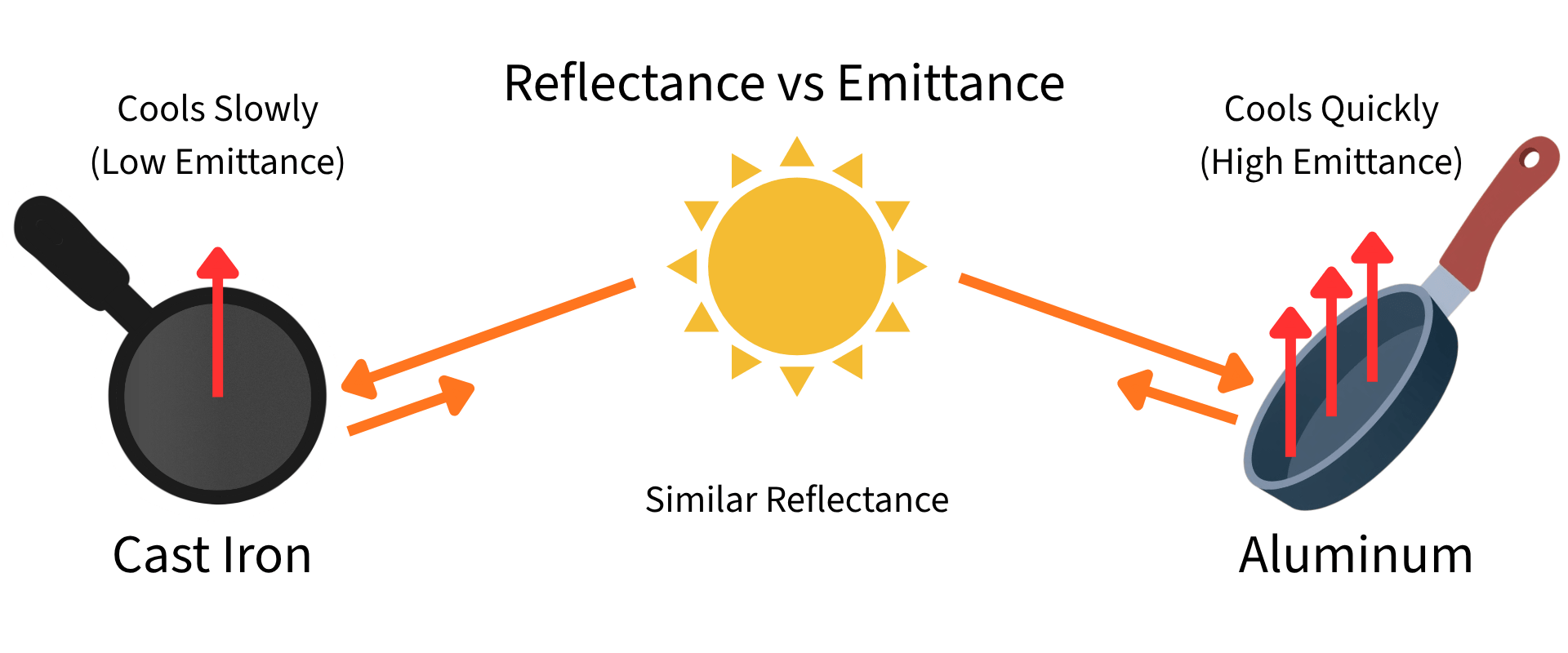
Consider two roof surfaces that reflect exactly the same amount of sunlight, say 65 percent. One is engineered to radiate absorbed heat efficiently. The other holds onto it. The first behaves like a radiator, shedding heat back into the air and cooling down as the sun moves. The second behaves like a brick oven, staying hot long after you'd expect, even well past sunset.
That second property, the rate at which absorbed heat gets released, is thermal emittance. It's the reason SRI exists. A high-performing cool roof coating needs both high reflectance and high emittance, and SRI rolls them into a single number so you can compare products without doing the math yourself.
What counts as a "good" SRI?
It depends on the application, but here's a rough reference:
| Material | Typical SRI |
|---|---|
| Standard black asphalt shingle | 0 to 5 |
| "Cool" asphalt shingles | 29 and up |
| Unpainted or weathered metal roof | 30 to 50 |
| Cool metal roof coatings (painted or coated) | 70 and up |
| White TPO or PVC membrane | 85 to 104 |
| Premium reflective wall and roof coatings | 90 to 110+ |
For code compliance, most cool roof programs want a low-slope roof to hit an SRI of 75 or higher. Steep-slope thresholds are lower, usually around 29. Cool wall requirements are still catching up but follow the same principles.
For a concrete reference point, our SunShield Pro Solar-Reflective Wall & Roof Coating tests at SRI 102, which puts it in the upper end of the commercial cool roof category.
One honest caveat: higher SRI isn't automatically better for every project. In cold climates, a high-SRI roof also reflects winter sun that might otherwise help with heating. For most of the U.S. sunbelt the cooling savings far outweigh this, but it's worth thinking through in heating-dominated climates.
How to read a spec sheet
Two things are worth checking when you're comparing products.
Are all three values published? A serious cool roof or cool wall product will list solar reflectance, thermal emittance, and SRI. If you only see one (especially just SR), that's usually a sign the product isn't positioning itself as a true cool roof product, or the company hasn't done the full testing. Either can be fine for some uses, but it's good to know what you're looking at.
Is the product third-party tested? The Cool Roof Rating Council maintains a public directory of rated products with independent testing. Products listed in the directory are the safest bet for code compliance work. Products that advertise high SRI but aren't in the directory aren't necessarily lying, but the numbers haven't gone through the same verification.
Frequently asked questions
- Can SRI really be over 100?
- Yes. The 0-to-100 scale is calibrated against reference surfaces (standard black at 0, standard white at 100), not a physical ceiling. A material more reflective or more emissive than the standard white reference will score higher. High-end reflective coatings typically land between 102 and 110.
- Does color determine SRI?
- Mostly, but not entirely. Darker colors typically reflect less sunlight and have lower SRI. Modern "cool color" pigment technology can make darker-appearing surfaces reflect significant amounts of near-infrared light (about half of solar energy, even though we can't see it). A dark-looking roof with cool pigments can have a surprisingly high SRI.
- Is higher SRI always better?
- In hot climates, yes. In heating-dominated climates, the tradeoff is worth thinking through. A high-SRI roof reduces summer cooling loads but also reflects solar heat that might help with winter heating. For most U.S. climates the net effect is positive, but it's not a universal rule.
What next
- If you're evaluating a specific cool roof coating, check the CRRC Rated Products Directory for independently verified values.
- See how these numbers look on a real product: SunShield Pro Solar-Reflective Wall & Roof Coating, which publishes SRI 102 and full radiative specs.
- If you're not sure whether a reflective coating makes sense for your specific situation, our family-run team at US Paint Supply is happy to talk it through. We'll give you straight guidance, even if it means telling you a different approach is a better fit.