
Why Some Paint Colors Are Hard to Match: Tint Systems & Complex Colors
Posted by Tommy Ekstrand on 12/07/2025
Highlights
- Matching a color exactly between brands is not possible. Getting close enough is the trick.
- The quality of the match depends heavily on the color you're matching. Simple colors(1-3 colorants) are easier to match accurately than complex colors(3+ colorants).
If you've ever asked, “Can Sherwin-Williams match a Benjamin Moore color?” or “Can I get a C2 color in another brand's paint?”, you're really asking a deeper question: how well do different color systems talk to each other? This article walks through how paint color matching works, why some colors are easy to copy and others aren't, and what that means if you're trying to match C2, Benjamin Moore, Sherwin-Williams, or any other brand across systems.
We'll keep the focus on real-world decisions: when a match is “good enough,” when it can get you into trouble, and how full-spectrum, multi-pigment color systems fit into the picture.
How Paint Color Matching Actually Works
Most modern color matches start the same way, no matter what brand is behind the counter:
- You bring in a chip, fan deck color, or painted sample.
- The store puts it under a spectrophotometer(shortened to spectro going forward) – a device that measures how the color reflects light at many wavelengths across the visible spectrum.
- The software sees that reflectance data and asks: “Using my tint system (my colorants and bases), which formula gets me closest to this curve?”
- It generates a starting formula, and the staff may tweak it visually if needed.
A spectro doesn't know anything about the original recipe. It doesn't see “3 drops of yellow, 2 of red, no black.” It only sees the result – the way that color behaves in light – and then tries to recreate that with a different set of tools.
That's why it's possible to get surprisingly good matches between brands in some situations, and why some matches look completely off once you get them home.
What Is a Color System (Tint System)?
Every paint brand with in-store tinting works with a specific color system – sometimes called a tint system. At a basic level, that system consists of:
- Colorants: Highly concentrated liquid pigments that get added at the tinting machine.
- Bases: The untinted paint (white, medium, deep, accent) that those colorants are added into.
- Formulas: The recipes that say how much of each colorant goes into each base to create each color.
Two brands can offer a very similar-looking paint line on paper, but when they use different colorants they essentially speak different languages. The spectro acts like a translator, but it's still limited by the tools it has.
Simple vs. Complex Colors: Why Some Are Easy to Match
This is where “how many colorants” really starts to matter.
Broadly, you can think of colors in two buckets:
1. Simpler colors (fewer colorants)
- Typically built from one to three colorants plus black in many mainstream systems.
- Spectral curve (the graph the spectro sees) is relatively smooth and simple.
- Easier to match in another system because there are fewer "notes".
2. More complex colors (3+ colorants)
- Built from multiple clean colorants in small amounts. At US Paint Supply, we typically think of any color with more than 3 colorants as complex.
- For example, with C2 Paint, many colors are formulated with roughly 5-8 different pigments per color with no black colorant in full-spectrum colors.
- The spectral curve has more structure: small bumps, dips, and inflections.
- Much harder for another tint system, with different pigments and stronger reliance on black, to copy precisely.
A helpful metaphor
Matching a complex color in another brand is like a cover band trying to play a song written for a full orchestra – but with only violin, bass, and flute. You still recognize the song, but the depth and harmonies aren't identical.
Seeing the Difference on a Spectrophotometer Graph
Complex, Multi-Pigment Color vs. an Attempted Match
- Original: A multi-pigment(complex) color with a more detailed, wavy curve.
- Match: A different brand's attempt to reproduce that curve using fewer, different colorants.
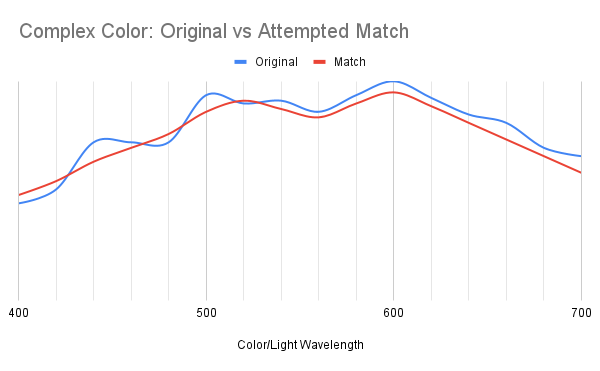
They may look very close overall, but you'll notice they diverge at specific wavelengths. Those small differences are why two colors that seem identical in the store can look significantly different at home under LED, daylight, or warm incandescent light. That phenomenon is called metamerism – colors that match in one lighting condition but separate in another.
Simpler Color vs. Match
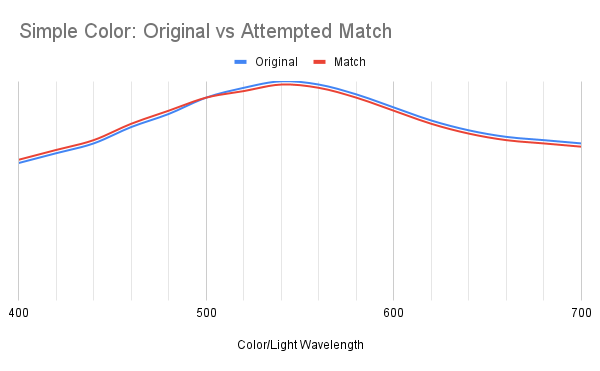
That's why a basic off-white or straightforward navy is usually much easier to match between brands than a nuanced greige or a full-spectrum neutral.
How Many Colorants Go Into a Color – and Why It Matters
The number of colorants used in the formula for a specific color (not the number of colorants available in the system) can affect three primary attributes:
- How “clean” or “muddy” the color looks
- How the color shifts in different light
- How hard it is for another system to match
Typical mainstream approach: 1–3 colorants plus black
Many large manufacturers build a lot of their colors using just a few base colorants plus black. That approach has advantages:
- Primarily, it's efficient and cost-effective.
- Formulas are shorter and easier to dispense consistently.
- Neutral and darker colors are relatively easy to match between systems.
But it also means many colors are fundamentally similar under the hood – which can translate to:
- More reliance on black to darken colors (which can sometimes mute or “gray out” colors).
- Less nuance in subtle neutrals or off-whites.
Complex, Full-Spectrum Approach
Some paint systems, C2 for example, were deliberately built the opposite way. Instead of using as few colorants as possible, complex colors are often formulated with 5–8 distinct pigments per color, and full-spectrum colors are designed with no black colorant at all.
In practice, that means:
- Colors tend to feel richer and more natural, because more of the spectrum is represented.
- They often shift more gently throughout the day as the light changes, rather than flipping from “too gray” to “too beige.”
- The spectral curve is more complex – which makes it much harder for another brand's smaller set of colorants to copy accurately.
From C2's perspective, that complexity is a feature, not a bug. It's part of why designers and color-sensitive homeowners gravitate toward full-spectrum color systems in the first place.
Does “More Tint” Make the Paint Better or Worse?
“More tint” can mean two different things, and it's worth separating them:
- Number of colorants used in the formula (e.g., 2 vs 7 different pigments).
- Total amount of tint poured into the gallon (how much colorant overall).
Using more different pigments in smaller amounts (complex colors) can actually help a color feel more balanced and interesting, without overloading the paint. The base was designed to handle that multi-pigment structure.
But pushing a base to its limit with very high tint load – especially with older “universal” colorants – can start to affect:
- Dry and cure time
- Film hardness and scrub resistance
- Sheen uniformity (how even the finish looks)
That's why deep and accent bases exist: they're engineered to accept more colorant without breaking the paint. A well-designed system balances the chemistry of the base with the chemistry of the colorant. When you're comparing brands, it's not just “how many drops” – it's how well those drops are designed to live in that specific paint.
If you want to dig deeper on this chemistry side, our article Gennex vs Universal Colorants: Why the Tint System Matters in Paint walks through how tint systems affect coverage, VOCs, and durability.
Why Matching Across Brands Is Sometimes “Close Enough” – and Sometimes Not
Putting all of this together, here's a practical way to think about cross-brand matching.
Situations where a match is often “good enough”
- Touch-ups in low-visibility areas (inside closets, behind appliances).
- Small accent pieces where the original color isn't nearby for direct side-by-side comparison.
- Simple colors.
- Projects where schedule or local availability matters more than an exact match.
Situations where matching across systems is riskier
- Complex colors, especially neutrals (greiges, off-whites, subtle taupes).
- Whole-room or whole-home repaints where the original color stays on some surfaces.
- Full-spectrum systems like C2 that use many pigments and no black in key colors.
- Spaces with variable lighting where metamerism (light-dependent shifts) will be more obvious.
In those cases, you may get a match that looks great on a chip or in the store but reads slightly greener, grayer, or duller once it's on a full wall – especially when you compare it directly to the original system.
Practical Advice: How to Decide When to Match and When to Stick With the Original Brand
It's probably safe to match when:
- You're painting a small piece and the original color won't be seen right next to it.
- The color is straightforward (bright blue, slate navy, clean red, etc.).
- You understand and accept that “very close” is okay, even if it's not mathematically perfect.
Stay with the original color system when:
- You're extending an existing C2, Benjamin Moore, or Sherwin color across more rooms.
- You're working with subtle whites, grays, or greiges where undertones really matter.
- You're specifying finishes for clients and need reproducible results across multiple jobs.
- You've chosen C2 specifically for its full-spectrum look and don't want to lose that character.
When in doubt, a good middle path is to:
- Ask the store to tint a small sample in the “match” color.
- Paint that sample next to the original color in your actual room.
- Check it in daylight, evening, and artificial light before committing.
How This Applies Specifically to C2 Colors
We're going to plug C2 specifically here, not because we sell it, but rather the opposite. We sell C2 Paint because it has full-spectrum, complex colors as is owned by a partnership of small businesses.
C2 is unusual in that it:
- Uses a 16-colorant system, more than many mainstream brands.
- Formulates many colors with 5–8 different pigments per color rather than one or two plus black.
- Intentionally avoids black colorant in its full-spectrum colors to preserve clarity and depth.
Those choices are great if you want rich, nuanced color that feels alive in changing light. They also mean:
- Other brands' tint systems often don't have the same set of “instruments” to recreate those colors.
- Matches can get into the ballpark on lightness and general hue but miss some of the subtle undertones and glow.
- Two colors that measure close in a spectro report can still feel different on the wall, especially at scale.
If you're planning a project around a C2 color, it's usually best to stay inside the C2 color system rather than trying to have another brand match it. If you've never used C2, dive deeper into C2 vs. other premium paints in our comparison guides like Benjamin Moore Aura vs C2 LUXE Interior Paint and Sherwin-Williams Emerald vs C2 LUXE.
Frequently Asked Questions About Matching Between Color Systems
Can any paint store match any color?
This depends heavily on the original color. Most stores can get reasonably close to simple colors using a spectro and their tint system. But “can they put something similar in a can?” is different from “can they perfectly reproduce a complex, multi-pigment color from a different brand, in all lights, on all surfaces?” The more complex the original color, the less likely another system can truly duplicate it.
Why does my matched color look fine on the chip but wrong on the wall?
Small samples hide a lot. On a full wall, differences in undertone, sheen, and how the color reacts to changing light become much more obvious. A match that's slightly cooler, warmer, duller, or more gray may be invisible on a 2" chip but very noticeable across a whole room.
Are C2 colors harder to match in other brands?
Generally, yes. C2's use of many pigments per color and no black in full-spectrum colors means its spectral curves are more complex. Another brand's tint system often can't recreate that structure exactly, so matches may look flatter or shift differently in light, even when the numbers say they're “close.”
Does using more colorants always weaken the paint?
Not automatically. What matters is how the base and colorants are engineered together. A well-designed multi-pigment system can maintain strength and durability while delivering richer color. Problems tend to show up when a base is overloaded with tint or when the colorant chemistry isn't well matched to the paint.
Is it okay to get a cheaper brand to match a more expensive brand's color?
"Okay" is relative to your personal opinions. When you do this, you're trading more than just the logo on the can. You're changing the resin system, base quality, and tint system behind that color. For some projects that's fine, especially if budget and availability are the main drivers. For color-critical spaces or high-wear interiors, sticking with the original product line is safer.
Will repainting everything with the matched color hide the differences?
Repainting all related surfaces with the new, matched color does help, because there's nothing left to compare directly against the original. But if you're sensitive to undertones or lighting shifts – or you chose a full-spectrum color specifically for its character – you may still notice that the new color doesn't “feel” quite the same.
Can Sherwin-Williams match a Benjamin Moore color?
Sherwin-Williams can usually get reasonably close to many Benjamin Moore colors using a spectrophotometer and its own tint system. However, the two brands use different bases and colorant systems, so Sherwin-Williams is recreating the appearance of the color, not the original Benjamin Moore formula. Simpler colors (built from one to three colorants, often with black) tend to match better than more nuanced tones. You can read more about that in the section on simple vs complex colors. If the exact color is important—especially for a full room or subtle neutral—your safest option is to buy it in the original Benjamin Moore paint.
Can Benjamin Moore match a Sherwin-Williams color?
Benjamin Moore can often produce a close visual match to many Sherwin-Williams colors using a spectrophotometer and the Gennex tint system. Because the bases and colorants are different, it can't reproduce the Sherwin-Williams formula exactly, only approximate how it looks. Simple, straightforward colors are more likely to match cleanly than complex neutrals or full-spectrum-style shades (see simple vs complex colors). If you're sensitive to undertones or planning a large, continuous space, we recommend using the original Sherwin-Williams color in its own paint line.
Can Behr match a Sherwin-Williams or Benjamin Moore color?
Home centers that carry Behr can usually generate a “close enough” match to many Sherwin-Williams or Benjamin Moore colors. They'll measure your sample with a spectrophotometer and then translate it into Behr's tint system. This works best for simpler colors and basic whites; more complex or finely tuned colors are harder to duplicate accurately (see simple vs complex colors). If you care a lot about the exact look—especially for designer neutrals or subtle off-whites—it's still best to use the original brand when you can.
Can Valspar match a Benjamin Moore or Sherwin-Williams color?
Valspar retailers can usually get fairly close to many Benjamin Moore or Sherwin-Williams colors by scanning a chip or fan deck sample and then formulating a match in Valspar's tint system. Because the colorants and bases are different, this will never be a one-to-one formula match; it's an approximation of the visual result. Simple colors tend to translate better than complex ones, where undertones and full-spectrum effects are more pronounced (see simple vs complex colors). For color-critical projects, we recommend buying the color in its original brand whenever possible.
Can PPG match a Sherwin-Williams or Benjamin Moore color?
PPG stores and dealers can typically create a close match to popular Sherwin-Williams or Benjamin Moore colors using a spectrophotometer. The match is limited by PPG's own colorants and bases, so the formula will not be identical to the original brand. You'll usually get something very close for straightforward colors, but more complex neutrals and designer shades may shift slightly warmer, cooler, or duller (see simple vs complex colors). If you need the color to look exactly like what you chose from a Sherwin or Benjamin Moore deck, sticking with that brand's paint is the safest choice.
Can ACE / Clark+Kensington match a Benjamin Moore or Sherwin-Williams color?
Many ACE Hardware stores can scan Benjamin Moore or Sherwin-Williams colors and then mix a Clark+Kensington match. As with any cross-brand match, ACE is using its own tint system and bases to approximate the look of the original color. Simpler colors often come out quite close, while more nuanced neutrals or full-spectrum-style colors are harder to reproduce accurately (see simple vs complex colors). If you've built a design around a specific Benjamin Moore or Sherwin color and want maximum fidelity, we recommend buying it in that brand's paint when possible.
Can Glidden match a Behr or Sherwin-Williams color?
Glidden dealers can usually attempt to match Behr or Sherwin-Williams colors using a spectrophotometer and Glidden's own tinting system. The result is a visual approximation; the underlying pigments and resin systems are still Glidden's. Matches for basic colors—simple blues, grays, or whites—are often close enough for many projects. More complex or finely tuned colors, especially subtle neutrals, are more likely to show small differences in undertone or depth (see simple vs complex colors). If that nuance matters to you, it's best to stay with the original brand.
Can California Paints match a Benjamin Moore or C2 Paint color?
California Paints retailers can generally scan and match many Benjamin Moore or C2 colors into their own products. That said, Benjamin Moore, C2, and California Paints all use different colorant systems, so they can't replicate each other's formulas exactly—only approximate the way they look. Simple colors are more likely to match well; more complex, multi-pigment or full-spectrum-style colors will be harder to duplicate (see simple vs complex colors). If you chose a specific C2 or Benjamin Moore color for its subtlety, getting it in the original brand is the most reliable option.
Can C2 Paint match a Benjamin Moore or Sherwin-Williams color?
Many C2 dealers can scan Benjamin Moore or Sherwin-Williams colors and mix a C2 match. Because C2 uses a 16-colorant, full-spectrum tint system, the match is created inside C2's own framework rather than copying the original brand's recipe. Simple colors often translate well, but more complex Benjamin Moore or Sherwin-Williams colors—especially those that rely on different pigment combinations or black—may not behave exactly the same in all lights (see simple vs complex colors). If you're trying to preserve an existing Benjamin Moore or Sherwin color perfectly, using that brand's paint is still the safest route.
Can other brands match a C2 Paint color?
Other paint brands can certainly attempt to match a C2 color by scanning a chip or sample, and some will get reasonably close for certain shades. However, C2's full-spectrum system often uses 5–8 pigments per color from a 16-colorant set, with no black in many colors, which creates a more complex spectral “fingerprint” than many mainstream lines. That complexity makes C2 colors harder to duplicate exactly in another brand's simpler tint system (see simple vs complex colors). If you chose a C2 color specifically for its depth and nuance, we strongly recommend getting it in C2 paint.
Can Farrow & Ball match other brands' colors?
Farrow & Ball can sometimes tint colors that are similar to other brands, but their strength is in their own curated palette and proprietary tint system. If you bring them another brand's color, they may be able to get close, but the formula and underlying pigments will still be Farrow & Ball's. As always, simpler colors are easier to match than complex or highly tuned neutrals (see simple vs complex colors). If you specifically want a Sherwin-Williams, Benjamin Moore, or C2 color, your best bet is to buy it in that brand's own paint.
Can other brands match a Farrow & Ball color?
Many stores will try to match Farrow & Ball colors into their own paint lines using a spectrophotometer. You can often get something in the same general family, but because Farrow & Ball's pigments, resin systems, and finishes are different, the result won't be an exact duplicate. This is especially true for nuanced, desaturated colors and complex neutrals, which are harder to recreate in simpler tint systems (see simple vs complex colors). If you care about keeping the exact Farrow & Ball look, we recommend using their paint.
Can Fine Paints of Europe match other brands' colors?
Fine Paints of Europe offers high-performance coatings and can sometimes approximate other brands' colors, but they're still working within their own tint system and product chemistry. Any match will be a Fine Paints of Europe interpretation of that color, not a cloned formula. Simple, bold hues are typically easier to bring over than subtle neutrals or full-spectrum-style shades (see simple vs complex colors). If you want the exact look of a different brand's color, the most reliable approach is to use that brand's paint.
Can other brands match a Fine Paints of Europe color?
Other brands can attempt to match a Fine Paints of Europe color with a spectrophotometer, but the result will always be constrained by their own tint system and resin technology. You may get close enough for some projects, particularly with simpler colors, but more complex or highly saturated shades are harder to replicate precisely (see simple vs complex colors). For projects where you chose Fine Paints of Europe specifically for its color and finish, sticking with the original products is the best way to preserve that look.
What Next?
If you're planning a project that involves matching colors across paint brands, or you're curious about how C2's full-spectrum system compares with mainstream lines, here are some good next steps:
- Explore our big-picture guide Interior Paint Brands Compared: SW, BM, Behr, Farrow & Ball, C2 & More for context on where each brand's lines sit.
- Get to know C2's interior paints, including C2 LUXE and other interior finishes.
- If you're a designer or contractor, consider ordering C2 sample pots or Ultimate Paint Chips(17"x24") so you can see the full-spectrum difference on real walls.
And if you're not sure whether to match across brands or stay in the original system, our family-run team at US Paint Supply is always happy to talk through your project and help you choose the path that makes the most sense for how you actually live and work in your space.