
Professional-Grade Paint vs Big-Box Paint: What's Actually Different?
Posted by Tommy Ekstrand on 01/14/2026
If you've ever wondered whether professional-grade paint vs big-box paint is truly a different product (or just a different price tag), you're not alone. The short version: paints can look similar on the shelf, but they're often designed for different customers, workflows, and performance expectations.
In this guide, we'll break down what typically changes between pro-grade and big-box formulas—solids and fillers, adhesion and durability, touch-ups, and the practical things contractors look for that most homeowners never think about (until there's a problem).
Quick comparison: pro-grade vs big-box paint
| What you're comparing | Professional-grade paint | Big-box paint |
|---|---|---|
| Who it's designed for | Contractors, designers, and repeat users who care about consistency, efficiency, and long-term results | Broad DIY/homeowner audience with a wide range of experience levels and budgets |
| What "value" means | Total job cost: fewer coats, faster application, fewer callbacks, predictable outcomes | Up-front cost, wide availability, easy shopping decision |
| Solids, pigment & fillers | Higher-performing resin/pigment packages with fewer tradeoffs (varies by product line) | Formulated to hit specific price points and mass-market expectations (varies widely by tier) |
| Hide & coverage | More consistent hide across bases/colors; better "one-coat potential" in real workflows (still depends on color and surface) | Can be fine in lighter colors; deeper colors and tricky substrates may need more coats or a better primer system |
| Flow/leveling & touch-ups | Smoother application, fewer brush/roller marks, more forgiving touch-ups | May be optimized for DIY friendliness; touch-up and "flashing" vary significantly by sheen/line |
| Adhesion & durability | Stronger resin systems and better long-term film performance are common in premium/pro lines | Durability ranges from "fine for low-wear rooms" to "surprisingly tough," depending on the specific tier |
| Support & guidance | More likely to come with dealer-level guidance on primers, substrates, and edge cases | Self-serve; while store support exists, it's unlikely you'll find the expertise you need for anything beyond the most simple questions. |
Professional-grade paint vs big-box paint: what actually differs?
Here's the most important mindset shift: the "channel" (big-box vs independent dealer) isn't automatically the quality. Many major manufacturers make excellent paints. And some big-box paints perform well for the money.
But the reason pro-grade products often feel "better" on the wall comes down to what they're engineered to do:
- Professional-grade paints are commonly designed to reduce labor time and risk. Painters make money (or keep their sanity) by finishing faster, fixing fewer issues, and avoiding callbacks.
- Big-box paints are commonly designed to satisfy the broadest number of shoppers across budgets and skill levels, with strong convenience, consistent availability, and approachable price tiers.
Those are both valid goals. They just lead to different formulation and performance tradeoffs.
One brand name, multiple formulas: why comparisons get confusing
One key point that trips people up: the same manufacturer can sell different paint lines through different channels.
For example, big-box-friendly brands and store lines (think: Behr, Valspar, and other retail-focused lines) are often built around retail realities: specific price points, high-volume tinting systems, and broad DIY use cases. Meanwhile, those same parent companies (or major manufacturers) may also offer premium or professional lines elsewhere that prioritize different performance targets.
That's why "Brand A vs Brand B" arguments usually miss the point. What matters is the specific product line and how it's designed to perform in real conditions.
Solids, pigment, resin, and fillers (in plain English)
Paint is basically:
- Resin (binder): the "glue" that makes paint stick and form a durable film
- Pigment: This is both the white(typically titanium dioxyde) in the base, plus the color that is dispensed at time of tinting. These provide color and opacity (hiding power)
- Fillers/extenders: help control sheen, texture, cost, and workability
- Liquids: water/solvent plus additives that help it apply and dry correctly
When pros talk about "solids," they're usually talking about how much of the wet paint remains as a dry film after it cures. In general, a stronger, better-performing paint film tends to come from:
- Higher solids count in the base(better coverage/hiding)
- Higher-quality resin systems (better adhesion, durability, color "fastness")
- Effective pigment packages (better colors)
- Balanced use of fillers (fillers aren't "bad," but over-reliance reduces performance in certain areas)
Important reality check: "Higher solids" doesn't always mean better paint. Two products can have similar solids and still behave differently due to resin quality, pigment selection, and how the formula is balanced for flow, leveling, and touch-ups. The best use of solids is as one data point—not the whole story.
Adhesion and durability: where pro-grade paints often earn their reputation
When paint fails, it usually fails in predictable ways:
- Peeling or poor bonding to the substraight(surface being painted)
- Premature wear in high-traffic areas
- Scuffing, burnishing (shiny rub marks), or "washing off" over time
- Water spotting or inconsistent sheen after cleaning
- Color fading over time, especially in UV exposed areas
Professional-grade paints are often built to reduce those issues by using stronger binder (resin) systems and more robust additive packages—especially in higher-end lines meant for demanding interior use or exterior exposure.
If you want an apples-to-apples way to compare durability, look for data points on product sheets such as scrub resistance testing, recommended use areas, and substrate prep requirements. (And remember: surface prep and priming often matter as much or more than the topcoat.)
Hide, flow & leveling, and touch-ups: the "jobsite" differences people actually feel
Homeowners tend to evaluate paint by how it looks when the job is done. Pros evaluate paint by how it behaves while they're working—because that determines time, labor cost, and the odds of a call-back.
Hide and "how many coats will it take?"
Better hide isn't just about saving paint. It's about saving time and reducing risk:
- Fewer coats means fewer chances for lap marks, missed spots, and texture differences.
- More predictable coverage means easier estimating and smoother scheduling.
- Less paint used is better for our environment.
Big-box paints can cover very well — especially in lighter colors and in higher tiers — but pro-grade paints often aim for more consistent results across a wider range of colors and bases.
Flow and leveling (brush/roller marks)
"Flow" is how paint spreads; "leveling" is how well it smooths out after you apply it. Better flow/leveling often means:
- Cleaner cut-ins
- Fewer visible brush strokes on trim and doors
- A more uniform finish on walls under strong side-lighting (windows, sconces, etc.)
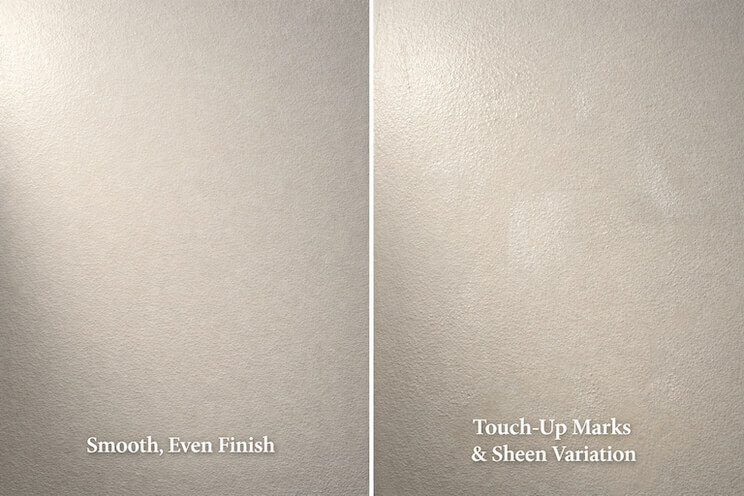
Touch-ups (the most underrated performance category)
Touch-up behavior is where many "fine" paints start to frustrate people. A paint that doesn't touch up well can show:
- Flashing (a dull or shiny patch where you touched up)
- Color shift depending on application method (brush vs roller)
- Visible "picture framing" around the repaired area
Professional-grade paints frequently put real emphasis on touch-up consistency because it saves time and prevents headaches—especially in occupied homes, commercial spaces, and warranty work.
Why big-box paint is often optimized differently
"Big-box" isn't a synonym for "bad." It's a different ecosystem. Retail paints sold through high-volume stores are often designed around realities like:
- Mass distribution and shelf stability (consistent performance after sitting in warehouses and on shelves)
- Broad usability for a wide range of skill levels
- Fast, standardized tinting at scale
- Clear merchandising and tiering (budget/value/premium/ultra premium price points)
Those are legitimate design targets. But they don't always perfectly align with what professionals prioritize, such as maximum coverage efficiency, high-touch durability, and reliable touch-ups across varied substrates and jobsite conditions.
How pros evaluate paint (and how you can, too)
If you want to compare paints the way a contractor does, try this checklist the next time you're deciding between lines:
- What surface am I painting? (new drywall, previously painted walls, stained wood, cabinets, exterior siding, etc.)
- What's the failure risk? (humidity, sun exposure, kids/pets, frequent cleaning, cooking grease, etc.)
- What's the labor cost? Even if you're DIY, your weekends are worth something.
- How forgiving does this need to be? (touch-ups, lap marks, brush marks)
- Do I need a specific primer? Many "paint problems" are actually "primer problems." Be wary of brands that don't have their own primer.
- Am I comparing the same tier? Don't compare a store's entry-level line to a brand's flagship and call it a fair test.
That last point is huge. If a brand sells a lower-tier line through a big-box store to meet a specific price point, it's not a surprise that the brand's top-tier or pro-focused line (sold elsewhere) may outperform it.
When big-box paint is a smart choice
Not every project needs an ultra-premium product. Big-box paint can be a practical choice when:
- You're painting a ceiling or a low-wear area
- You're refreshing a low cost rental.
- You're working on a tight budget, in a space where the lifespan of the paint isn't important, and you'd rather allocate money to prep, patching, and primer
The "best" paint is the one that matches the job. Sometimes the best move is upgrading the primer and staying mid-tier on the topcoat. Other times—high traffic, deep colors, design-critical spaces—premium paint pays you back in fewer coats and fewer issues later.
What about independent paint brands?
Some paint brands intentionally stay out of big-box retail. Here at US Paint Supply, we've chosen to carry C2 Paint. C2 is one of the independent brands - some would say the only true independent - and the reason isn't just distribution strategy; it's part of the origin story.

C2 was founded in 1998 by the head chemist from Pratt & Lambert, alongside independent paint dealers who wanted a higher-end line they could own and control, at a time when consolidation was pushing many products toward commodity pricing and "lowest common denominator" formulas. Hill has described the idea as creating room for a specialty paint company "like a microbrewery."
That dealer-driven model still matters today: C2 is structured around an independent dealer co-op approach, where the people closest to the paint — dealers, color-lovers, designers, and sales people - working with end users—help guide decisions. It's a very different philosophy than mass-market paint designed primarily for big-box scale.
Practically, what you'll notice about a brand like C2 is an emphasis on:
- Quality above all (coverage, adhesion, washability)
- Designer-forward color (C2 is known for complex(3+ pigment) and full spectrum(no black) color development)
- Dealer-level support for selecting the right product and system for the job
If you're curious where that fits in a project, US Paint Supply carries C2's ultra-premium categories here:
FAQ: professional-grade paint vs big-box paint
Is professional-grade paint always worth it?
If your highest values are lifespan, color, durability, touch-ups, or application time, it will be worth it. If your job doesn't require those things, then it's unlikely to be worth it.
Is "contractor paint" the same as professional-grade paint?
No. Some "contractor" or "builder" paints are designed to meet price targets for new construction, where speed and cost are prioritized and the expected wear level may be lower. Professional-grade typically refers to paints engineered for higher performance and fewer jobsite problems—not simply a paint that contractors buy.
Do big brands sell lower-quality paint at big-box stores?
Sometimes, yes—in the sense that most manufacturers sell multiple tiers, and the lines designed for big-box retail may be formulated to hit specific price points and broad DIY use. That doesn't mean they're "junk," and it doesn't mean the manufacturer can't make excellent paint. It just means you should compare the specific product line and tier—not the logo on the can.
How can I compare paints fairly across brands?
Compare within the same tier (e.g. ultra premium vs ultra premium), in the same sheen and base, and then look at: recommended use areas, scrub/durability testing info, application notes (touch-ups, recoat windows), and primer requirements. If one paint is designed for "easy DIY refresh" and another is designed for "high-traffic commercial corridors," they're not aiming at the same target. We've got a great paint brand & tier comparison.
Does higher solids content automatically mean better paint?
Not always, but it's often an indicator. Performance also depends on resin quality, pigment selection, and the balance of additives that impact flow, leveling, and touch-ups. It's one indicator, not a guaranteed ranking system.
What's the biggest real-world difference people notice after the job is done?
Other than color quality, it's often touch-ups and durability. A paint that resists scuffs, cleans well, and touches up without flashing tends to look "new" longer—and feels less stressful to live with.
Why isn't C2 sold at big-box stores?
C2 is independent by design. It was created as a dealer-driven, quality-focused alternative in an era of consolidation, and it continues to prioritize independent dealer support, curated color development, and premium performance targets rather than mass-market distribution.
What next
If you're deciding between a big-box option and a professional-grade product, start with the room's demands (traffic, cleaning, moisture, sun exposure) and your tolerance for extra coats and tricky touch-ups. If you want to explore an ultra-premium, independent-by-design paint line, here are the C2 categories we recommend starting with:
And if you're stuck between two options, a quick description of your surface (and whether it's new, previously painted, glossy, stained, or high-traffic) is often enough to point you toward the right system—primer included.